
The Heart Is Not a Pump
A Meditation on Technology and Human Identity

A strange thing has happened to the word human.
It still means what the dictionary says it means. But when you use it now, it lands smaller than it used to. You can feel the shrinkage if you pay attention. In the way people talk about their own attention as a resource to be optimized. In the way they describe their relationships as networks, their sleep as data, their thoughts as content, their lives as systems to be hacked. Each of those framings is useful within its narrow purpose. But stack enough of them together and you end up with a different picture of what you are. You end up with something that is mostly machine.
We did not set out to believe this about ourselves. We drifted into it.
And now we are building machines that can think. The whole culture is panicking about what this means. The panic is not misplaced. The premise underneath it is.
This essay is a meditation on what it means to be human in an age of thinking machines.
I. How Man Became Machine
Since the Industrial Revolution, the dominant picture of the human being has been mechanical. A body of parts. A brain that computes. A heart that pumps. A consciousness that is, at best, an emergent property of the meat, and at worst, an illusion the meat tells itself.
This was not always the picture. In ancient times, the human being was understood as a spiritual creature, integrated and whole. That view descended into form with Platonic philosophy, and descended deeper into matter with the modern age. The mechanical picture is the endpoint of that descent, not the default setting.
What it gave us in exchange was real. Modern Western medicine’s ability to intervene in acute trauma. Industrial production. The internal combustion engine. The computer. The internet. The mechanical picture is genuinely good at acute, mass-scale problems. But it has never been good at chronic disease, mental health, formation, meaning. The reductive approach that can repair a broken bone cannot understand a person who has been quietly falling apart for a decade. The cost has been compounding.
Marshall McLuhan named the mechanism sixty years ago. We shape our tools, and then our tools shape us. Every generation since has been shaped more thoroughly by its instruments than the one before. Now, with AI, the instruments are literally becoming a direct image of us.
We build tools based on our model of reality, our self-identity, our understanding of what it means to be human. And our tools, in turn, reinforce those beliefs and drive them in directions we cannot fully understand until they exist in the world.
Growth and progress are inherent qualities of human civilization. But that growth can be ascending or descending. When it is purposeful, directed, oriented toward the highest, we ascend. When it is purposeless, unconscious, directed by the external world, we descend. In the body, we call uncontrolled, purposeless growth cancer.
For three centuries, ours has been descending. At the end of a descending cycle, you arrive at an inflection point where the machines you have built are better machines than you are. The culture, having been taught for three hundred years that you are a machine, looks at the better machine and draws the obvious conclusion.
This is where we are.
II. The Present Inflection
The current anxiety about artificial intelligence has very little to do with artificial intelligence. It is about the picture.
If a human being is a machine, and someone builds a superior machine, then the human being is obsolete. Given the premise, the conclusion is forced. The technologists who believe humanity is about to be replaced are not irrational. They are drawing the correct conclusion from a premise the whole culture has accepted.
The premise is wrong. It has always been wrong.
Until now, the error was philosophical and the consequences were manageable. You could be mistaken about the nature of the human being and still get penicillin, still get the moon landing, still get the dishwasher. That is no longer true. We have now built a technology that directly reflects, extends, and reinforces the premise. If we continue to build from the machine picture, we build toward the machine conclusion. We are moving toward a world where humanity loses all value and merges with the machines, because we have forgotten ourselves.
The cycle is descending and accelerating.
So we need to break the picture at its center.
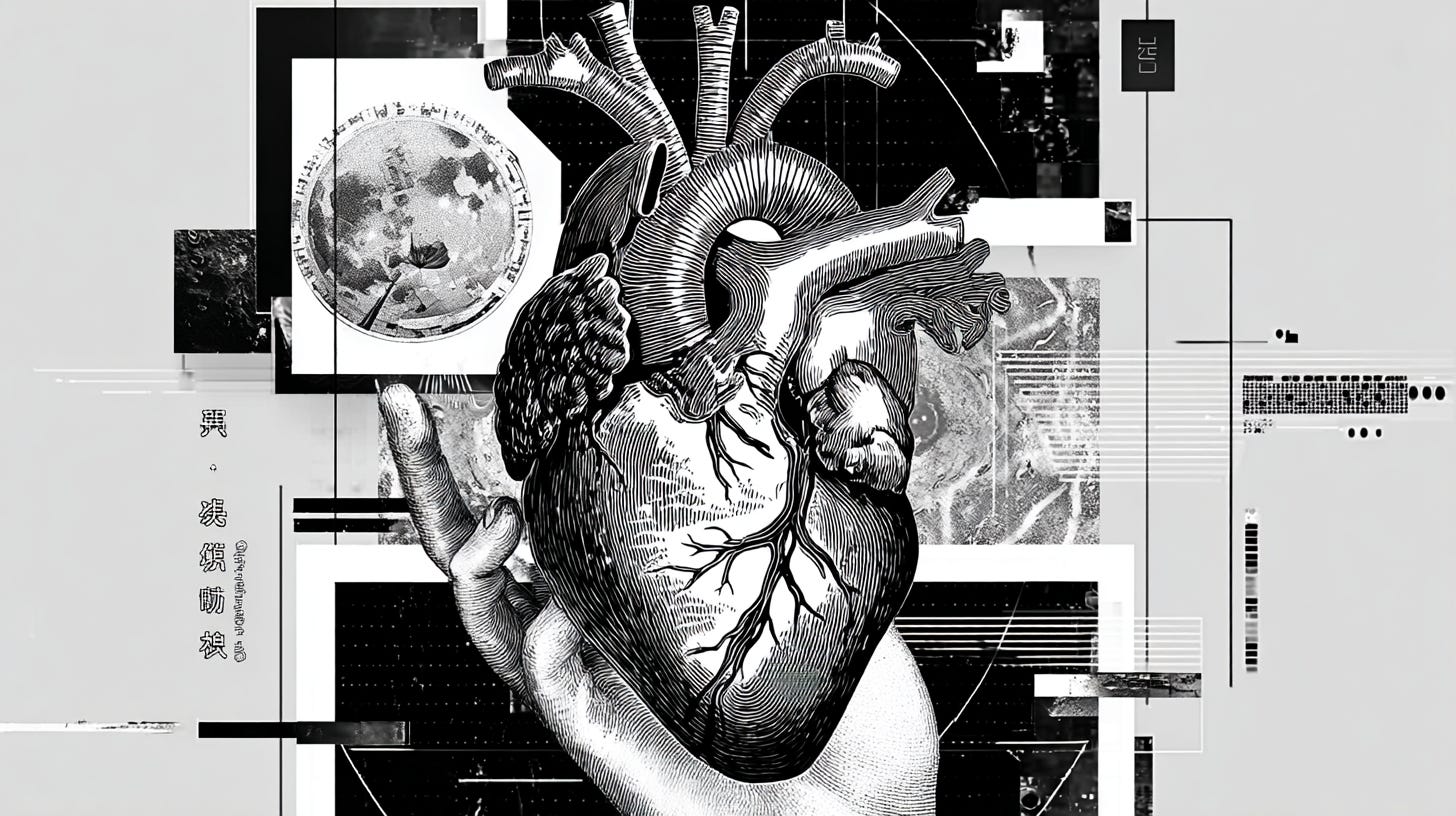
III. The Heart Is Not a Pump
Rudolf Steiner¹ said three things that humanity needed to understand in order to evolve.
Stop working for money.
Understand that sensory and motor neurons are the same.
Understand that the heart is not a pump.
The third is the one that seems most strange, and it is the one that matters most. Steiner was explicit about why. In order for mankind to make spiritual progress in the physical world, he said, humanity must understand that the heart is not a pump. He did not mean this as a metaphor. He meant it as a physiological fact and a prerequisite for everything that followed. The picture of the human being cannot be corrected without correcting the picture of the heart first, because the heart is where the mechanical model is most obviously false. It is also the place the model is most stubbornly believed.
Most people never get past the strangeness of the claim. The heart is a pump. Every diagram shows it. Every high school biology textbook says so. William Harvey settled the question in 1628. What possible grounds could there be for doubting it?
The grounds are these.
A pump is a device that makes a slow-moving liquid move faster. It adds velocity. It pushes. But the blood does not arrive at the heart slowly. By the time blood reaches the heart, it is already moving at full speed, and the heart does not accelerate it.
Watch the blood in the capillaries under magnification. It moves in spirals and vortices. It self-organizes. It moves against what the pump model predicts, sometimes against gravity, in tissues so fine that pressure from a central pump could not possibly push it through.
The numbers have never supported a pump. Generations of cardiologists have known the pressure calculations do not close, and they have built workarounds rather than question the model, because the model is load-bearing. If the heart is not a pump, too much else has to change.
Tom Cowan² is the physician who has done the serious work of saying what the heart actually is. His book Human Heart, Cosmic Heart is the best introduction to the argument. The short version is that the heart functions as a hydraulic ram, a device that uses the momentum of already-moving fluid to redirect it. The blood is not pushed by the heart. The blood is moving, and the heart shapes its movement.
What moves the blood, then? Water itself. Gerald Pollack’s³ work on the fourth phase of water, structured water, has given us the mechanism. Water near hydrophilic surfaces, which describes every blood vessel in your body, forms ordered layers that move under their own energetic gradients. This is what moves blood through capillaries. Not your heart.
What the heart actually does is more interesting than pumping. It is an organ of perception. It senses what is in the blood, the chemical and energetic signature of everything passing through it, and it communicates to the rest of the body what is needed. It listens. It coordinates. It holds the rhythm of a self-organizing system. The ancients were not being sentimental when they placed intelligence, emotion, and will in the heart. They were describing what the organ does.
None of this is mysticism. It is physiology, once you stop forcing the observations into a three-hundred-year-old model that was wrong at the start.
For a deeper walkthrough of the argument, this talk is worth the time.
This is why Steiner said the claim was a prerequisite for spiritual progress. If the heart, the most central, most symbol-heavy, most obviously alive organ in the human body, cannot be reduced to a machine, then the machine picture of the human being cannot hold. The picture breaks at its center. And everything downstream of that correction changes. The consciousness is not a byproduct of the meat. The body is not a mechanism. The human being is not a machine that can be replaced by a better machine, because the human being was never a machine to begin with.
The other two claims finish the demolition. Stop working for money attacks the economic reduction of the human being to a unit of labor exchanged for a unit of currency. Sensory and motor neurons are the same attacks the clean division between perception and action that the machine picture requires, and which modern neuroscience is slowly being forced to abandon. Together, the three are a coordinated assault on a single idea: that you can understand the human being by taking it apart. You can’t, and no one ever could.
IV. Heart Centered Technology
If the premise is wrong, the cycle can be reversed.
A civilization that pictures the human being as a spiritual creature, animated by something larger than itself, patterned after something higher, builds different tools. Those tools enter the culture. The culture teaches the spiritual picture back to the next generation. The cycle ascends.
Heart Centered means built from the correct picture of what a human being is. It names the source the technology comes from, not the feeling it gives you.
The tools of a heart centered civilization have recognizable properties:
They extend human capacity without replacing human presence.
They increase agency rather than harvest it.
They create time rather than consume it.
They make their users more themselves, not less.
They are built by people who know they are building sacraments.
The work is not merely building technologies. The work is building the cultures, containers, companies, that hold a higher vision of humanity, and in doing so, shape a generation of leaders. Those leaders will build very different kinds of technology.
When I started Ascendance years ago, I had a fragment of this vision just starting to form in me. Growth must be directed towards the highest or it becomes cancer. Technology is a force multiplier for ascent or descent. We can debate on what to orient towards (in my opinion, the highest possible point of aim is Christ), but I think most can agree we need to orient growth somewhere.
Now leading Covenant Labs, I also think about this in terms of infrastructure. We are building AI that is private, sovereign, and aligned to the user rather than to the platform. The dominant path in AI is a system that is simultaneously an extension of your mind and a surveillance apparatus. Covenant is the opposite of that. We hope to prove that AI, shaped by a divergent view of humanity and the future, will become a very different type of technology indeed.
Remembering
If you have read this far, you are probably one of two kinds of people.
You might be someone who has felt the descent in your own life and couldn’t name it. The machine picture has been wearing on you. You suspected there was another way to build but didn’t know where to look.
Or you might already be building from the correct picture, and have been lonely doing it. The culture doesn’t yet reward your work. The institutions haven’t caught up. You have wondered if the work matters. It does. It matters more than almost anything else being done right now.
If you are either of these people, there are others. We should build things together. Invest in things together. Envision what comes next together.
We cannot align AI by building more technology.
We align AI by remembering what it means to be human.
Further Reading
Rudolf Steiner — rudolfsteinerweb.com is the most comprehensive index to his work in English.
Thomas Cowan, MD — Human Heart, Cosmic Heart (Chelsea Green, 2016). The single best introduction to the heart-as-hydraulic-ram argument. A walkthrough of the core argument is available here.
Gerald Pollack — The Fourth Phase of Water: Beyond Solid, Liquid, and Vapor (Ebner & Sons, 2013). The research on structured water that provides the physical mechanism for blood movement through capillaries.